

Much like a glider, a human powered aircraft can’t really do much on the ground without assistance – there’s a good reason most pictures of HPAs on the ground will see them surrounded by people. Even the fittest pilot capable of providing the power for an unassisted takeoff cannot provide the control to balance and directional control prevent the aircraft from going off-kilter… or simply falling over.
HPAs are designed to be as light as possible, which means the dangly bits are there to absorb takeoff and landing loads – not to provide steering or balance. Thus, ground crew are critical to launching – and just as importantly, landing.
The Racing Rats
First off: we’re just going to focus on the people assisting with launching and landing. Ground crew also rig aircraft and move them between taxiway and runway – however, each plane rigs differently and has its own quirks re moving about, so these operations are outside the scope of this post.
There are two groups we’re interested in today:
- Runners, who assist with takeoff
- Chasers, who assist with landing
Common to both of these roles: the aim is to help the aircraft safely take off or land without injury to the pilot or ground crew, and minimal (or zero) damage to the aircraft.
Wednesday Morning, 4AM
If you’re not familiar with HPA ops… we do early mornings. When the Icarus Cup is on, we do over a week’s worth of them. Nobody’s going to be on their A-game at that point, so you’ll have to actively push yourself to stay awake and attentive. Your brain will constantly be trying to shut down, and as far as my experience goes the only reliable way to stave this off is by plying it with food and water. Caffeine also helps, as long as it’s not used as a substitute for either.
Whoever’s in charge at the time will provide a briefing before each flight. Make sure you’re clear on the planned flight and what’s expected of you. Example details to look out for:
- Which bit of the aircraft should you be holding or grabbing? Sounds like a daft question, but HPA’s are fragile and getting this wrong could be very bad.
- What’s planned – a long flight, or a short hop?
- Who’s flying – are they experienced, or new to this?
- Are you running or chasing? Or both?
- Are you assigned to the boom or the wings? Which wing?
If you’re unsure about anything, ASK. I’ve seen avoidable mistakes terminate perfectly good flying sessions, and nobody comes out of those looking happy.
First Steps
Before you volunteer, know that you’ll be doing a lot of short sprints – this is high-impact, high-speed stuff. Lift rises with velocity squared, so most HPAs take off faster than running pace. Be confident you can run good before you volunteer.
And make sure you’re wearing decent running shoes – You’ll be running on tarmac runways, which will be tough on your joints. Work or hiking boots are more water-resistant, but the ankle support will slow you down.
Gloves also help with not skinning your hands if you trip, and preventing metal or carbon splinters.
My personal preference would also be to wear a helmet in case you stack it, especially if you’re chasing (I’m honestly amazed more people don’t fall over), but this is rarely done.
And now: onto the running bit!
Slow Cheetahs
There are three running positions: port wing, boom, and starboard wing. Sometimes the boom runner is called “javelin”.
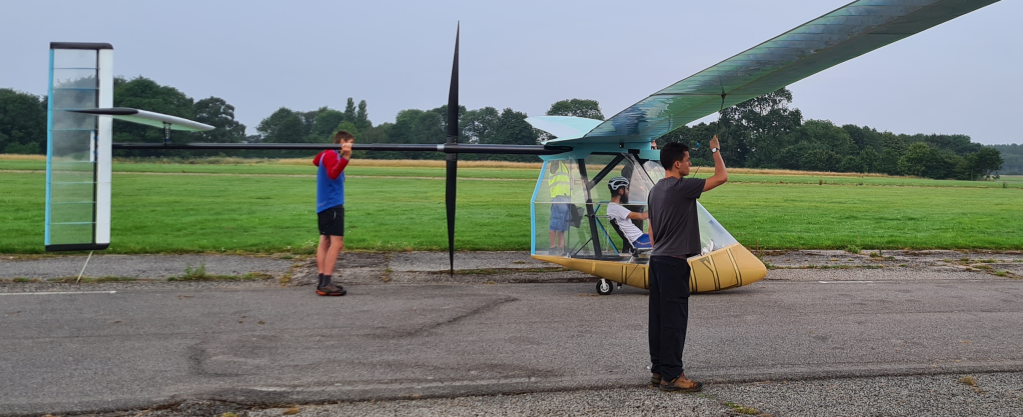
Wing runners will usually be pulling/pushing (speed depending) the aircraft along by the bracing wires, as seen above. Sometimes there are cutouts in the mylar which will let you use your other hand to grab the spar directly. Make sure to ask whoever knows the plane where you shouldn’t grab.
Depending on the aircraft, the boom runner may be just behind the propeller, or behind the tail surfaces. See below:
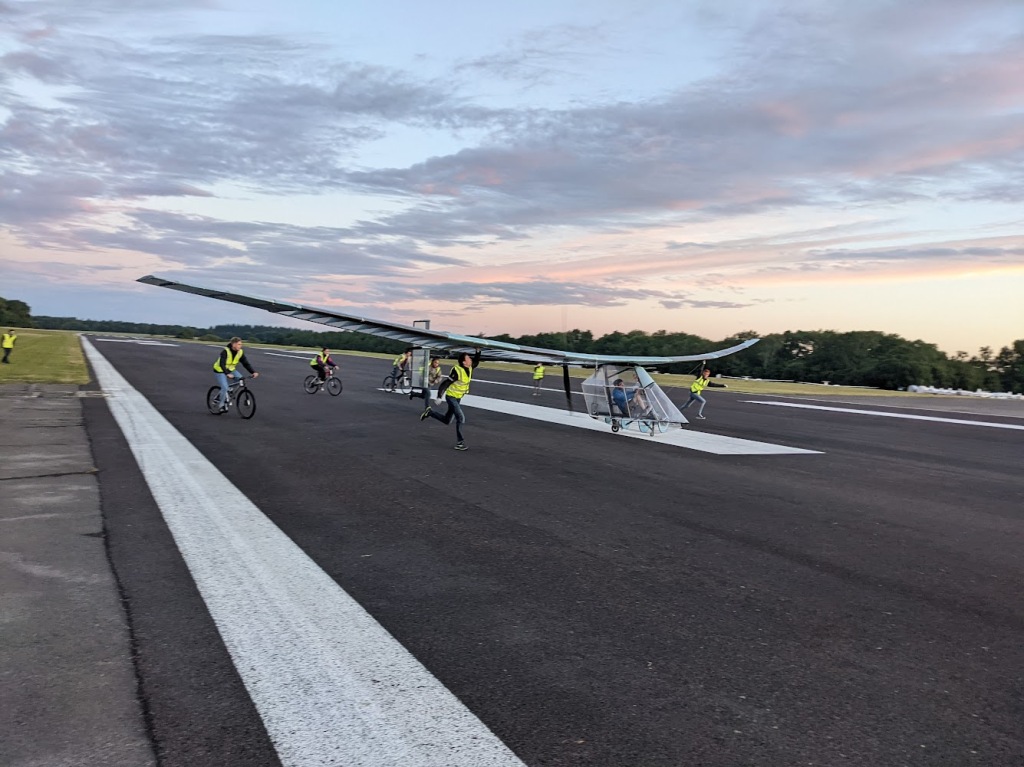
Many aircraft will need the boom runner to be behind the propeller or pod, but in front of the tail surfaces – with takeoff speed exceeding running pace, being struck by a tail surface is possible and has happened several times in the past. HPAs being delicate beasts, this has always resulted in the fin detaching/breaking off, without injury to anyone.
Note: there’s often a lot of standing around to HPA ops, and this can get very tiring on noodly cycling/running arms. If you find yourself standing around for too long with no indication of imminent takeoff, it’s ok to ask for relief – or at least extra support elsewhere on the wings to take some of the load off.
Call Me Maybe
Launching requires some serious coordination between ground crew and pilots – however, the wingspans of HPAs can make hearing one other difficult. Thus we try to limit ourselves to a series of standard callouts:
- “Clear prop!” – The propeller is about to start swinging, and you should make sure you’re out of the way. This could be in preparation for takeoff, or could simply be because the pilot is clipping into (or out of) the pedals. Either way, big swinging bladed item causes pain when interrupted by flesh. This callout may be made several times before takeoff and after landing, so don’t assume once it’s made that’s it.
- “Walking” – The pilot has warmed up and is starting the takeoff run. Runners start walking forward, pulling the aircraft slightly along with them. The propeller will be stalled at low speeds, so takeoff assistance is most critical here.
- “Running”/ “All out!” – The pilot is putting maximum power into the pedals. Runners will only be providing a small pushing force by this point as they start to run out of speed and the propeller starts to bite. The wing will be generating enough lift to remove a significant load from the runners.
- “RELEASE!” – one of the runners has let the aircraft go – either because they’ve run out of speed, or because the aircraft has lifted off. If anyone (including the pilot) hears this, they should repeat it loud and clear. All runners must get clear of the aircraft. The aircraft should take off in the next few seconds.
If all has gone well, the aircraft will be climbing out to below the 7m (or so) maximum recommended altitude, and there will be great rejoicing.
Intermission: The Aerocycle Exception
As far as I’m aware the guide on chasers below will apply to any old HPA, including the Betterflys (Betterflies?), Airglows and Lazaruses. However, it doesn’t apply to Aerocycles.
Aerocycles have very stiff wings, relatively high wing loadings, low drag, and pretty good control authority. They’re also very stable on the ground. This tends to mean that takeoff and landing speeds are fairly high, and that the aircraft are usually pretty good at going where the pilot wants, and tend to balance themselves out once landed. For contrast, Betterfly has a much lower wing loading and… well, pretty shonky controls. The former point blesses it with low takeoff and landing speeds and easy flying characteristics. However the naff controls (the rudder deflection appears to be nearly doubled in one direction and halved and coupled slightly with the elevator in the other) and low wing loading mean that the plane tends to get blown about a lot. Thus ground crew are needed to shepherd the planes on and near the ground.
Upshot of all this: Aerocycle needs ground crew to launch, but chasers are only needed to secure the plane once it’s more or less stopped (unless there’s a hazard present that requires intervention).
Not flying Aerocycle or want to know how to stop it in an emergency? Read on.
Can’t Stop/Won’t Stop
During short hops and test flights, wing runners will often be expected to double as chasers – unless advised otherwise, boom runners can stop once clear of the aircraft. Runner/chaser roles should be made clear to everyone before the flight.
If this is the case: once “RELEASE” is called, drop back – but stay in your spanwise position and try to stay just behind the lifting wires you used to take off.
STAY BEHIND THE WINGS. There’s nowhere to grab the plane from the pointy end that won’t damage it… and you’ll have an aeroplane running you down. I could post footage of this… but I don’t want to. So here’s an artist’s impression:
Except in this case, the bus will probably be damaged and the cars will only feel slightly ashamed.
Don’t accidentally end up drifting to the other wing, or you might run into the other runner/chaser and leave the aircraft even more vulnerable.
All but the cycling bit of the next session will apply, so read on for a fuller breakdown of how to stop a moving aeroplane.
Finish the Flight
Assuming a long flight… for the chasers, this is where the fun begins. Note this guide only covers flying down the runway in a straight line – anything involving turns will require specific briefings before each flight.
Rough rundown from just before the takeoff run is as follows:
- Grab a bike you’re ok with dropping at speed… ideally make sure it’s yours. If you didn’t bring a suitable bike, make sure you’ve found the chase bike’s owner and asked their permission to use it. Fancy bikes are not for roughhousing.
- Move into position behind the tail or outboard of the wingtips, and make sure you have a clear path ahead.
- Keep back during the takeoff run and let the runners do their thing. Remember: if the flight just turns into a short hop, the runners will catch the plane.
- Once RELEASE has been called, allow the runners space to peel off – then attempt to keep pace with the aircraft. Keep a safe distance behind, but try to be in a place where you can comfortably drop the bike at speed.
- When touchdown appears imminent, get as close behind as safely possible, drop your bike, and transition into a sprint to catch up. As far as I’ve seen, this is never easy nor graceful – but it does usually work.
- Keep pace until the aircraft has touched down. Grab your bracing wire or designated grabbing thing, and let the plane come to a halt. Don’t try to drag it back (unless it’s an emergency), or you may cause a ground loop – remember, there are two chasers and the other one may need time to catch up!
Catch Me if You Can
Let’s assume you’re trying to catch a wing wire – a realistic prospect given the HPAs we have flying in the UK. Some tips for this:
- Again: do not get in front of the wing. Chances are things will just go wrong.
- If the plane has touched down but your wing is rising, move inboard – the wire will be lower nearer the fuselage pod. Try not to jump to grab the wire unless it’s absolutely necessary – this can overstress the wire joiner, which will be connected to the main spar.
- If your wing has fallen below hip level, back off and don’t try to catch it – you’ll probably just damage the trailing edges.
Safety Sprint
If there’s a hazard ahead (e.g. airfield perimeter fence, or bears) that can’t be outmanoeuvred and the plane needs to stop NOW: the only vaguely safe method I’m aware of is getting into the sprint earlier and grabbing the wing wire – and pulling DOWN and BACK. This is likely to damage the aircraft and you may in fact end up falling over – but vital HPA parts are designed to take some punishment, and the community are excellent at field repairs. What matters is that you’ve stopped the pilot (who cannot run away) from being seriously injured… and possibly saved the plane from being destroyed.
Some HPAs do have brakes, but never assume this.
Fortunately HPAs don’t carry enough energy to merit consideration of the trolley problem – but if you do see people lying down on the runway, something has gone seriously wrong and you should check on them when the aircraft has been safely brought to a halt.
To Let a Good Thing Fly
To reinforce a point made earlier: make sure you know what you’re supposed to be doing before the takeoff run starts. If you’re unsure, ask whoever’s in charge of the flight. If you’re tired enough that you know you’re likely to make bad decisions, ask for someone else to take over.
And finally, some general stuff to keep in mind:
- Briefings are very important.
- You will be shouting and running and cycling around a field for ~4 hours. Food and water are very important.
- Everyone will be tired and not at peak alertness. If you need to say something, you will often need to POINT AND SHOUT.
- Take layers to the field! Even in mid-summer, early mornings can be cold. Since you’ll only be running or chasing for relatively short intervals, you won’t necessarily be able to warm up.
- Bikes with flat handlebars are a lot easier to use for chasing than spindly drop-bar road bikes, and are typically a lot more capable of soaking up punishment.
- Wings are heavy, and can flex a lot. They will feel lighter as they start lifting, but when the aircraft is touching down, it can feel like the plane is trying to squash you. Sometimes the safest thing to do for yourself and the aircraft is just to let go and fall back.
- I once saw a chaser cycle into a wing’s trailing edge. Remember to ditch your bike before trying to catch a moving aeroplane. If this means you can’t catch it… scraping the ground will do a lot less damage than being rear-ended by >70kg of flesh and metal.
- Chasers are often the only people near the aircraft at the end of a flight, so will probably be expected to push it back into position (assuming the aircraft isn’t being flown back up the runway – we don’t like tailwinds).
- If you need support, chances are the people who rigged the aircraft will still be present – ask for help, and it will be given.
 BHPFC
BHPFC 
Leave a comment